


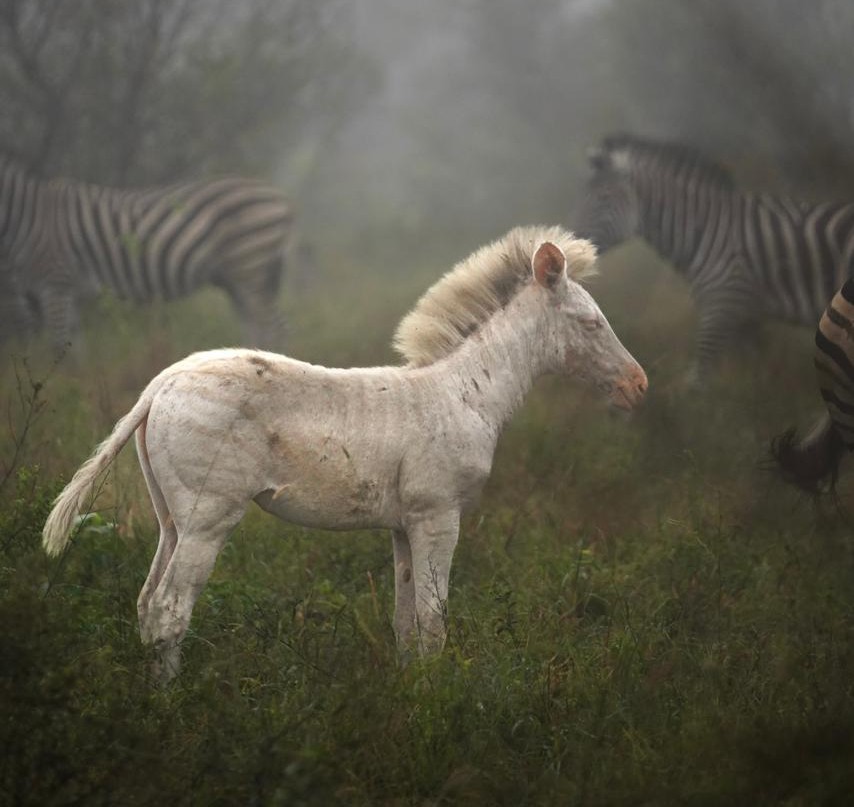

A Ghost in The Dazzle
This zebra foal, almost entirely white, stands in stark contrast against the dazzle’s black-and-white stripes. Where this (more-than-decorative pattern) has become synonymous with the bushveld plains, this little one carries only the faintest illusion. Soft, washed-out shadows on its neck and flanks are visible only when light catches at the right angle. From a distance, it appears pure white. Visible pink skin and a pale, almost translucent eye have become central to the conversation around her condition.
Traversing the unfenced Sabi Sand – a 65,000-hectare wilderness sharing open borders with Kruger National Park – the foal was finally spotted at Umkumbe Bush Lodge late in April. Because the Sabi Sand is traversed freely by its zebra populations, the foal and her dazzle have been making ‘surprise’ appearances since then.
Sightings of the foal continue to be reported across the Sabi Sand. Guests visiting Umkumbe Bush Lodge over the coming weeks may be lucky enough to glimpse. However, as with all wildlife sightings, nothing is guaranteed. The privilege of the moment is part of the magic.

The Stripes Don’t Make the Zebra
News of the white foal began circulating via the ‘bush telegraph’ roughly a month ago, when guides at several lodges began comparing notes on it. Soon, photographs were circulating, and by now the sighting had gone from a curiosity to a phenomenon. As of this week, she is still being seen regularly, still moving with her mother, and – encouragingly – still very much alive.
White zebras are extremely rare. Only a handful of cases have been documented across the entire African continent. A free-roaming white foal in a reserve as well-watched as the Sabi Sand is a once-in-a-generation event. What has made this particular sighting so widely discussed, however, is not just the foal's appearance – it is the debate over its cause.
Is the White Zebra Albino or Leucistic?
While the foal was initially described by some as an albino foal, experts and guides across the Sabi Sand also speculate about leucism as a likely diagnosis. Although opinions are split, the distinction is genuine and worth understanding.
The case for albinism rests on the foal's overall appearance: an almost pure white coat with only the ghost of stripes, visible pink skin where the hair is sparse, and a pale, light blue eye. True albinism is caused by a complete absence of melanin, which is the pigment responsible for colour in skin, hair, and eyes. Typically, albinism produces pink or pale blue eyes along with pink-tinged skin. The pale eye and the visible rosy skin around her muzzle both fit this profile.
The case for leucism rests on the partial nature of the pigment loss. Leucism is a genetic condition in which pigmentation is only partially produced rather than entirely absent. Leucistic animals retain melanocytes (the pigment-producing cells), but those cells fail to deposit pigment evenly across the coat. Crucially, leucistic animals usually retain normal eye colour because the condition does not affect the eyes the way albinism does. The fact that this foal does have some faint striping, rather than being uniformly white, is one of the strongest arguments in favour of leucism over true albinism.
The visible cues point in slightly different directions, and even seasoned guides are split. Guides at Umkumbe Bush Lodge lean towards leucism as the cause. However, what the debate has highlighted, more than anything, is how rare these variations are in plains zebras.
Survival Challenges
The same traits that make this white foal so striking may also make her more vulnerable. Zebra stripes are not merely decorative. The patterns may create a visual “dazzle effect” that makes it harder for predators to isolate a single zebra within a moving herd. Without strong stripes, this foal may lose some of those advantages. Predators such as lions, leopards, and hyenas could find her more conspicuous. The lack of protective pigment in her skin may also leave her more susceptible to sun damage and minor skin irritations, as already seen on parts of the foal’s face.
For now, the best protection remains exactly what it has been since the day it was born: a watchful mother, a tolerant herd, and the collective vigilance of the dazzle around her.
What Will Nature Reveal?
As autumn turns into winter, we are excited for condensed wildlife encounters around watering holes and incredible views from our treehouse deck. Book your winter safari at Umkumbe Bush Lodge now, and trust nature to do the rest.
Never Miss an Encounter
Have updates and news from the bush delivered straight to your inbox. Subscribe to our mailing list for exclusive offers and inside information.
https://www.umkumbebushlodge.com/blog
More from Umkumbe Bush Lodge
Calling all young explorers! Are you ready to discover the wild side of Africa? When you visit Umkumbe Bush Lodge, you're not just coming on holiday with Mom and Dad. You're stepping into the incredible world of the African bush — where every game drive is a new adventure and you never know what you might find around the next corner!
Life in the bush is shaped as much by subtle detail as by size, strength and speed. Many of the animals found in the African savannah rely on patterns, colour, and markings as finely tuned survival tools. What may appear decorative or a special quirk can, in reality, be ways to camouflage, communicate, regulate body temperature, and outsmart predators.

